



The actual move is not the outcome
Many mobility programmes are measuring success too early. Relocation delivered, visa approved, assignment started and policy followed are important milestones, but they do not prove the assignment is working. This paper argues that employee experience is now part of assignment risk management, and that success needs to be measured beyond completion, across the full assignment lifecycle.

Executive summary
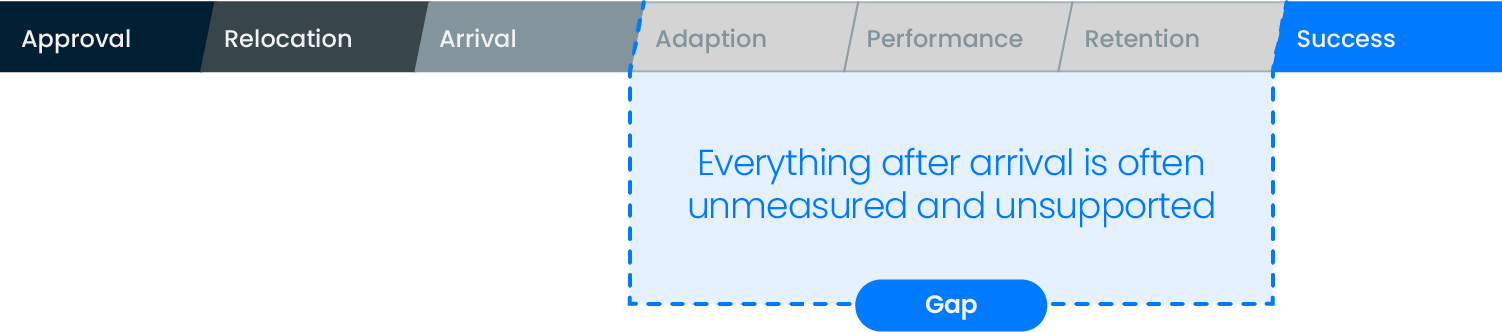
Global mobility programmes are typically measured by completion. Employees are relocated, visas are approved, and assignments begin. These milestones provide a clear sense of progress and, in many cases, are used as indicators of success.
However, there is growing evidence across the industry that completion does not necessarily equate to effectiveness. Employees arrive but take time to settle. Assignments begin but fail to deliver expected performance. Costs increase, yet the return on investment becomes harder to define.
This piece explores a simple but often overlooked idea. The move itself is not the outcome. It is the starting point of a much broader process that ultimately determines whether mobility delivers value to the business.
“Mobility programmes are rarely failing at delivery. They are underperforming in whatdelivery is supposed to enable.”
Rethinking how mobility defines success
Over the past decade, global mobility has become more structured, more specialised and more accountable. Organisations have introduced clearer policies, strengthened compliance frameworks and developed increasingly sophisticated supplier ecosystems. These changes have been driven by rising regulatory complexity, cost control requirements and the need to demonstrate governance at scale.
At the same time, industry research from organisations such as EY and ECA International continues to highlight a disconnect between mobility activity and business outcomes. While programmes are more operationally robust, many organisations still struggle to clearly link mobility to areas such as talent development, workforce productivity or market expansion. This challenge is compounded by changing employee expectations, where experience, transparency and support are becoming more influential in how assignments are perceived.
The result is a structural imbalance. Mobility programmes are optimised for what can be measured, such as timelines, cost and compliance, while the factors that determine whether an assignment actually works are less visible and less consistently tracked. Completion becomes a proxy for success, even though it represents only one stage of the assignment lifecycle.



Where mobility breaks down in practice
The gap between delivering a move and delivering a successful outcome is becoming increasingly important for mobility leaders.
KPMG’s 2025 Global Mobility Benchmarking Report found that demonstrating return on investment is now the number one challenge for mobility leaders, cited by 31% of respondents. At the same time, cost management as a top priority has fallen from 39% to 18%, signalling a shift in focus from simply controlling the cost of mobility to understanding the value it creates.
That distinction matters. A relocation can be completed on time, an immigration approval secured and an assignment delivered within policy — but these measures alone do not tell us whether the move achieved what it was intended to achieve.
The disconnect becomes particularly visible when mobility is considered as part of the wider talent strategy. KPMG found that 62% of mobility teams are not at all involved in advising on candidate selection for international moves, 68% are not involved in employee skills development and 60% are not involved in succession planning.
This creates a structural imbalance. Mobility may be responsible for successfully moving an employee, without necessarily being connected to the decisions about why that individual is moving, how the experience should contribute to their development, or what success should look like for the organisation.
The same challenge can play out across the mobility journey.
In relocation, programmes are typically well structured around key milestones such as home search, shipment and initial settling in. These stages are time-bound and supported by established supplier models. However, once these milestones are complete, the level of structured support can reduce while the employee and their family are still navigating local systems, building networks and adapting to everyday life.

The move may be complete, but the transition is not.
For more complex populations, such as senior executives and specialist talent, the limitations of standardisation can become more visible. These individuals may require greater discretion, flexibility and coordination. When programmes rely heavily on scaled delivery models, the experience can become fragmented or misaligned with individual and business expectations.
In immigration, compliance, accuracy and approval are rightly fundamental. Yet a technically successful outcome does not automatically create a positive employee experience. Communication, visibility and reassurance throughout the process can be just as important to the individual navigating it. An approval confirms that the process has been completed successfully; it does not necessarily tell us how effectively the employee was supported through it.
Assignment management faces a similar challenge. Policy, reporting and governance provide essential structure, but the tools used to measure mobility do not always provide the insight needed to understand its wider impact. KPMG found that 72% of mobility reporting and analytics is still managed through spreadsheets, compared with just 16% using dedicated analytics tools. This can make it harder to move beyond reporting activity, cost and completion towards understanding the value and outcomes mobility creates.
At the same time, the shape of international mobility is changing. 70% of organisations now use short-term assignments, reflecting the prevalence of more agile and project-based approaches to international deployment. As these models become more common, the need for mobility programmes to consider what happens beyond the initial move becomes even more important. Different assignment types may require different levels and forms of support, but the principle remains the same: completing the logistical elements of a move is only one part of delivering a successful outcome.
Taken together, these challenges point to a broader issue. Mobility teams are increasingly being asked to demonstrate value, while many remain disconnected from wider talent decisions and reliant on reporting structures that make that value difficult to measure.
The challenge for mobility, therefore, is no longer simply “Did we complete the move?” It is “What did the move achieve?”

What the evidence tells us
These patterns align with broader industry data. ECA International continues to report rising assignment costs without a consistent increase in perceived value. Research from EY highlights the ongoing challenge of linking mobility to business outcomes, while wellbeing data from providers such as AXA Global Healthcare points to increasing pressure on internationally mobile employees.
The direction is clear. Mobility is becoming more complex to deliver, but not necessarily more effective in what it achieves.
Redefining what success should look like
If mobility programmes are to deliver greater value, success needs to be considered across the full lifecycle of an assignment. This requires a broader perspective that reflects both operational delivery and lived experience.
In practice, organisations are beginning to introduce more deliberate ways of aligning programme design with real-world outcomes. This often includes extending structured support beyond arrival, particularly during the first months when employees and their families are adjusting to a new environment. It also involves introducing more meaningful touchpoints that focus on experience, rather than simply confirming that milestones have been completed.
There is also a growing emphasis on reducing fragmentation across services. Relocation, immigration and assignment management are often delivered separately, yet experienced as a single journey. Creating greater continuity between these elements helps to reduce friction and improve overall outcomes.
At a programme level, some organisations are beginning to revisit how success is measured. This includes incorporating indicators such as assignment completion, early return rates and post-assignment retention, alongside traditional metrics. It also involves increasing transparency for employees, particularly in areas where uncertainty is most likely to arise.
Traditional mobility view:

Lived experience:
Industry perspective: beyond the move
by Martina Romancikova, Client Account Manager
When an organisation relocates an employee, it invests in their ability to support growth, capability or commercial opportunity. Yet the period after arrival is often the least structured, despite employees navigating a new role, culture and environment alongside family adjustment. These experiences directly influence whether the assignment succeeds.
I believe there is an opportunity for more purposeful post-arrival support. Personal check-ins at 30, 60 and 90 days could explore confidence, wellbeing and adjustment, identifying concerns before they affect performance. Feedback should lead to practical support, while insights from those thriving can help improve future experiences. Employees must also understand how their responses will be used and feel safe speaking openly.
Success should therefore extend beyond delivery milestones to consider how well individuals and their families settle, adapt and perform. This need not make programmes more complex. It requires deliberate attention after arrival and a clear response to what we learn. The move is not the outcome. The value lies in what the individual feels able to achieve afterwards.


A closing perspective
Global mobility has matured into a structured, controlled and highly specialised function. This has brought consistency and scalability, but it has also created a risk that programmes become focused on maintaining process rather than delivering value.
The distinction between delivery and outcome is becoming more important as organisations place greater reliance on international talent. Moving employees is no longer the objective. Enabling them to perform, integrate and contribute is where value is created.
At K2 Group, this distinction has shaped how services are designed. Rather than operating as separate functions, relocation, immigration, assignment management and specialist support are structured as a connected model. The focus is on reducing fragmentation, maintaining continuity and ensuring that the employee experience remains visible throughout the lifecycle of an assignment.
This approach is grounded in a simple principle. Experience is not treated as an added benefit or a premium layer. It is fundamental to whether mobility delivers its intended outcome. That requires a willingness to challenge existing programme design, simplify where possible and adapt delivery to reflect how assignments actually unfold.
Prioritising experience in this way is not always the most efficient route in the short term. However, it is where mobility programmes move beyond completion and begin to deliver meaningful, measurable value.
